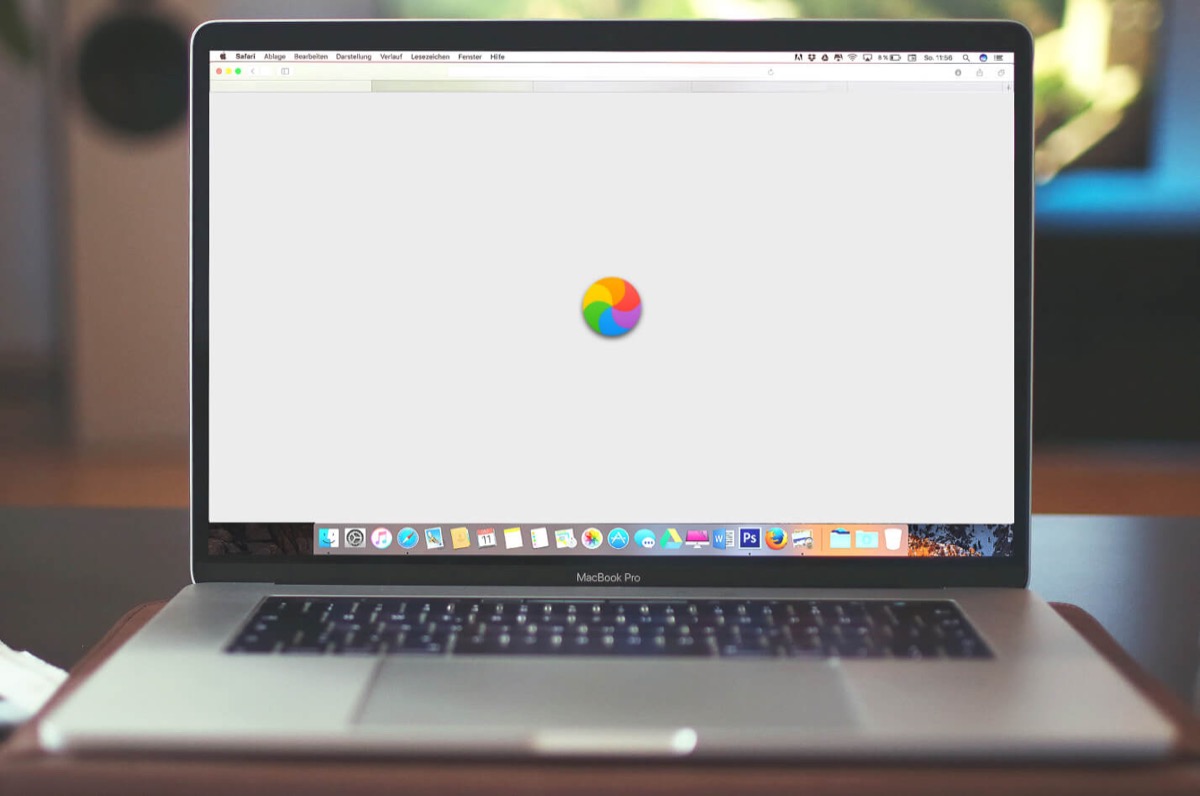
The spinning color wheel is the Mac’s wait cursor. Apple’s description is short: it appears when a delay of more than a few seconds occurs. Often one app is busy or has stopped responding. Wait a moment, and if the app does not recover, press Option-Command-Esc and force it to quit. If the wheel keeps coming back, check memory, storage and startup software with the steps below.
Stop the spinning wheel now
Wait, or switch to another app
Move the pointer over another window or the desktop. If it turns back into an arrow there, the rest of your Mac is working and only that app is busy. Give it a short while, above all when it is saving, exporting or opening a large file.
Force quit the app
- Press Option-Command-Esc, or choose Force Quit from the Apple menu.
- Select the app that does not respond.
- Click Force Quit.
Changes you did not save in that app are lost. If the Finder is the app that is stuck, select it in the same window and click Relaunch.
Use Activity Monitor if Force Quit does not show the cause
Open Activity Monitor from the Utilities folder in Applications, or search for it with Spotlight (Command-Space bar). A process that does not respond is shown in red and marked (Not Responding). Select it, click the stop button at the top of the window and choose Quit. Choose Force Quit only if Quit does not work, because the process may lose data.
If the whole Mac is frozen
- Try Apple menu → Restart.
- If the menu does not open, press and hold the power button for up to 10 seconds, until the Mac turns off. On a laptop with Touch ID, hold the Touch ID button.
- Press the power button again to turn the Mac back on.
A forced shutdown loses unsaved changes in every open document, so use it only when nothing else responds.
If the wheel keeps coming back
Update the app and macOS
If one app shows the wheel again and again, install its updates: the Updates section of the App Store for App Store apps, the developer’s website for others. Then check System Settings → General → Software Update. If the app still hangs after that, Apple’s next suggestion is to delete it and install it again.
Check memory and processor load
Open Activity Monitor and click Memory. The Memory Pressure graph at the bottom is the figure to watch. Green means the Mac is using its memory efficiently. Yellow means it might eventually need more RAM. Red means it needs more RAM. Sort the list by the Memory column and quit apps you are not using.
Then click CPU and click the heading of the CPU percentage column to sort by it. An app that stays at the top with a high value while you are not doing anything in it is a candidate for an update, a reinstall or a replacement. More detail is in our guide to freeing up RAM on a Mac.
Check free storage
A startup disk that is almost full is the first cause Apple lists for a slow Mac. Open System Settings → General → Storage to see how much space is free and to use the recommendations shown there. Empty the Trash and the Downloads folder and remove apps you no longer use.
Start up in safe mode
Safe mode starts the Mac without login items and extensions that macOS does not need, checks the startup disk and clears some system caches. It shows whether software that loads at startup is behind the problem. Apple recommends installing updates and unplugging accessories you do not need before you try it.
Mac with Apple silicon:
- Shut down the Mac.
- Press and hold the power button until you see “Loading startup options”, then release it.
- Select your startup disk.
- Hold the Shift key and click Continue in Safe Mode.
Intel-based Mac:
- Turn on or restart the Mac and immediately press and hold the Shift key.
- Release the key when you see the login window.
To find out which kind of Mac you have, choose Apple menu → About This Mac. A Mac with Apple silicon shows an item labeled Chip, an Intel-based Mac shows Processor.
Use the Mac in safe mode for a while, then restart normally to leave it. If the wheel stays away in safe mode and returns after a normal restart, a login item or other startup software is the cause. Remove login items in System Settings → General → Login Items & Extensions (Login Items in macOS 13 and 14) and restart. If the problem continues even in safe mode, Apple’s advice is to reinstall macOS, which does not remove your personal files.
Check the disk with First Aid
Disk Utility can find and repair errors in the way a disk is formatted and organized. Back up first. To check the startup disk, start the Mac from macOS Recovery, open Disk Utility and run First Aid on each volume, then on the container and the disk. Apple’s steps are in How to repair a Mac storage device with Disk Utility. The Repair Permissions button that old guides mention is no longer part of Disk Utility.
Test the hardware with Apple Diagnostics
If nothing above helps, rule out a hardware fault. Shut down the Mac and disconnect external devices except the keyboard, mouse, display, Ethernet and power.
Mac with Apple silicon:
- Press and hold the power button until you see Options, then release it.
- Press and hold Command-D until the Mac restarts.
Intel-based Mac:
- Turn on the Mac and immediately press and hold the D key.
- Release it when you see a progress bar or a request to choose a language.
Follow the instructions on the screen. If the test ends with a reference code, note it and give it to Apple or a repair provider. The details are on Apple’s page Use Apple Diagnostics to test your Mac.
If it happens only in your browser
When the wheel appears only in a web browser, look at what is open in it. Close tabs you do not need, quit and reopen the browser and turn extensions off one at a time to see whether one of them is the cause. For Safari, see how to speed up Safari on a Mac.
Kingpin, our private browser for Mac, has no extensions and blocks ads and trackers by default. It is a separate browser, not a repair for a Mac that is short of memory or storage.