Firefox blocks many trackers on its own, but it does not block ads. For that you need an add-on. The nine below are all listed on addons.mozilla.org and still maintained by their makers. They differ mainly in three things: whether they let some ads through by default, whether Mozilla gave them its Recommended badge, and how much of the web they ask to access. The list is alphabetical, not a ranking.
What Firefox blocks without any add-on
Enhanced Tracking Protection is on from the first start. In its Standard mode Firefox blocks social media trackers, cross-site tracking cookies, cryptominers and fingerprinters, based on a tracker list provided by Disconnect. Trackers hidden in ads and other page content are blocked only in private windows. To block them in all windows:
- Click the shield icon to the left of the address bar on any page.
- Click Privacy Settings.
- Under Enhanced Tracking Protection, click Advanced settings and select Strict.
Even Strict mode is tracker blocking, not ad blocking. Ads that are not on the tracker list still appear, and that is what the add-ons below are for.
The nine add-ons at a glance
| Add-on | Recommended by Mozilla | Works on | Main job |
|---|---|---|---|
| AdBlock for Firefox | No | All sites | Blocks ads, allows Acceptable Ads by default |
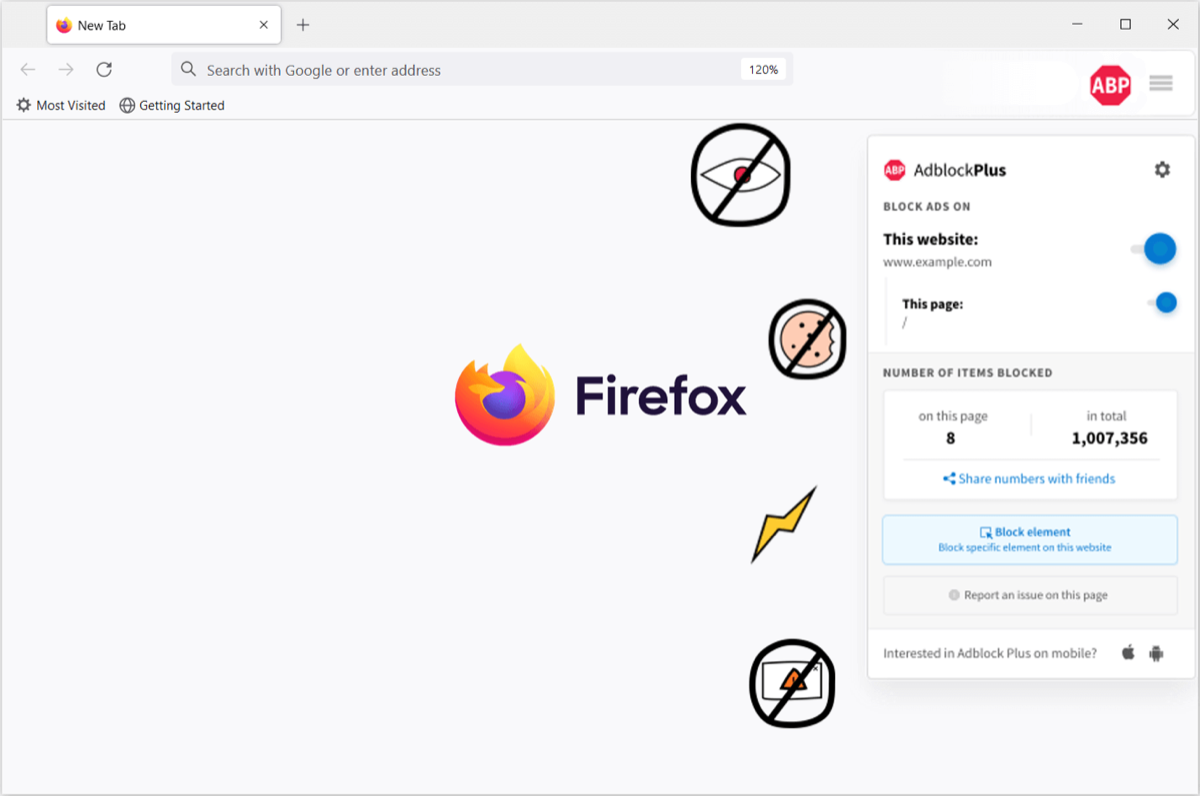
| Adblock Plus | No | All sites | Blocks ads, allows Acceptable Ads by default |
| AdBlocker for YouTube | Yes | YouTube only | Removes video and display ads on YouTube |
| AdBlocker Ultimate | No | All sites | Blocks ads, no allowlist for advertisers |
| AdGuard AdBlocker | Yes | All sites | Blocks ads and trackers with AdGuard’s own filters |
| AdNauseam | No | All sites | Blocks ads and clicks them in the background |
| Ghostery | Yes | All sites | Blocks ads and trackers, answers cookie pop-ups |
| Privacy Badger | Yes | All sites | Blocks trackers, not ads as such |
| uBlock Origin | Yes | All sites | Blocks ads, trackers and malware sites |
What the differences mean
The Recommended badge
Mozilla’s editors pick Recommended extensions themselves, and developers cannot pay for the badge. Before an add-on gets it, Mozilla’s security staff put it through a technical review, and checks continue afterwards. An add-on without the badge is not unsafe for that reason, but it has not gone through that review.
Acceptable Ads
Adblock Plus and AdBlock both take part in the Acceptable Ads program. Ads that meet the program’s criteria are on an allowlist and are shown unless you switch the option off in the add-on’s settings. Both add-ons come from the same company, eyeo. AdBlocker Ultimate and AdGuard state that they have no such program.
Access to your browsing
An ad blocker has to see every page to filter it. Eight of the nine therefore ask for access to your data on all websites. That is normal for this kind of add-on, and it is also the reason to install only one from a maker you trust. AdBlocker for YouTube asks for access to youtube.com only. All nine list an open-source license on their add-on page.
AdBlock for Firefox
AdBlock has been around since 2009 and came to Firefox from Chrome and Safari. It works right after installation with no setup. It suits you if you want ads gone and do not mind supporting sites through a small number of ads that meet the Acceptable Ads criteria.
Trade-offs: Acceptable Ads are shown by default, and you have to turn them off yourself if you want everything blocked. No Recommended badge.
Adblock Plus
Adblock Plus is a free blocker for all sites. Its own description says it supports websites by not blocking unobtrusive ads by default, and that this can be changed in the settings.
Trade-offs: the same as AdBlock, which belongs to the same company. Acceptable Ads are on until you switch them off, and the add-on has no Recommended badge.
AdBlocker for YouTube
AdBlocker for YouTube does one thing: it removes video and display ads on YouTube. It is the only add-on on this list that does not ask for access to all websites, and it has the Recommended badge. It suits you if YouTube ads are your only complaint and you want to give an add-on as little access as possible.
Trade-offs: it does nothing on other sites. The general blockers on this list also state that they block YouTube ads, so you do not need it next to one of them.
AdBlocker Ultimate
AdBlocker Ultimate is a free blocker whose maker says it has no “acceptable” ads and no allowlist of paying advertisers. It also blocks trackers and domains known for malware. You can still allow ads on sites you choose.
Trade-offs: no Recommended badge. The same company also offers separate apps for Windows, Mac and phones, which the Firefox add-on does not need.
AdGuard AdBlocker
AdGuard AdBlocker is a free extension with the Recommended badge. It uses AdGuard’s own filter lists, including separate filters for tracking and for social media buttons that you can switch on. It needs no account. It suits you if you want separate switches for ads, trackers and social widgets.
Trade-offs: AdGuard has no paid Acceptable Ads program, but it may leave search ads and a site’s own promotions visible. AdGuard’s documentation says you can turn that off. AdGuard also sells licenses for its desktop and phone apps. The Firefox extension works without one.
AdNauseam
AdNauseam is built on top of uBlock Origin and adds a form of protest: it hides ads and quietly “clicks” each blocked ad in the background, so that the profile ad networks build about you fills with noise. Its makers say the click is a text-only request that is thrown away before anything can run in the browser.
Trade-offs: it sends extra requests to ad servers, which a plain blocker avoids. By default it makes an exception for sites that follow the EFF’s Do Not Track policy. Its FAQ recommends turning off other ad blockers while you use it. No Recommended badge.
Ghostery
Ghostery combines three things: ad blocking, anti-tracking, and a feature called Never-Consent that removes cookie pop-ups and declines tracking for you. Its panel shows which trackers a page tried to load. It is free and has the Recommended badge. It suits you if you want to see who is tracking you, not only block it.
Trade-offs: like the other general blockers it asks for access to all websites, and it also asks for access to cookies.
Privacy Badger
Privacy Badger comes from the Electronic Frontier Foundation, a nonprofit. It does not work from hand-made ad filter lists. It blocks third-party domains that have been observed tracking people across sites, sends the Global Privacy Control and Do Not Track signals, and replaces social media widgets with placeholders you click to activate. It has the Recommended badge.
Trade-offs: the EFF describes it as a privacy tool, not an ad blocker. Ads that do not track you stay on the page. If you want all ads gone, the EFF itself suggests adding a traditional ad blocker.
uBlock Origin
uBlock Origin is a free, open-source content blocker whose author asks for no donations. Out of the box it uses EasyList, EasyPrivacy, Peter Lowe’s Blocklist, a blocklist of malicious URLs and its own filter lists, and you can add many more. It has the Recommended badge. Its author says it works best on Firefox, because Firefox gives extensions abilities that other browsers do not. Chrome no longer runs this version at all.
Trade-offs: the default setup needs no attention, but the advanced settings are technical. Its add-on page declares no data collection, yet like every general blocker it needs access to all websites.
Two add-ons you no longer need
HTTPS Everywhere was retired by the EFF, because browsers now do its job themselves. In Firefox, open Settings → Privacy and security, scroll to Connection and software security, click Advanced settings and turn on HTTPS-Only Mode.
Disconnect is still listed, but its Firefox add-on has not been updated since February 2024. Firefox’s built-in protection already uses Disconnect’s tracker list.
Install one blocker and allow it in private windows
One general ad blocker is enough. Firefox does not run a newly installed add-on in private windows unless you allow it:
- Click the menu button, then Extensions and themes, and select Extensions.
- Click the ad blocker.
- Next to Run in Private Windows, select Allow.
More detail is in our guide on using an ad blocker in private or incognito mode.
How to check an add-on before you install it
Every page on addons.mozilla.org shows what you need to judge an add-on yourself:
- The Recommended badge near the add-on’s name.
- Permissions and data: what the add-on can access and whether the developer declares any data collection.
- Last updated, under More information. Websites and filter rules change all the time, so an ad blocker with no update for a long time is a warning sign.
- License and the link to the privacy policy.
If you would rather not manage add-ons at all, Kingpin, our private browser for Mac, has no extensions and blocks ads and trackers by default with the EasyList, EasyPrivacy and uBlock Origin filter lists.