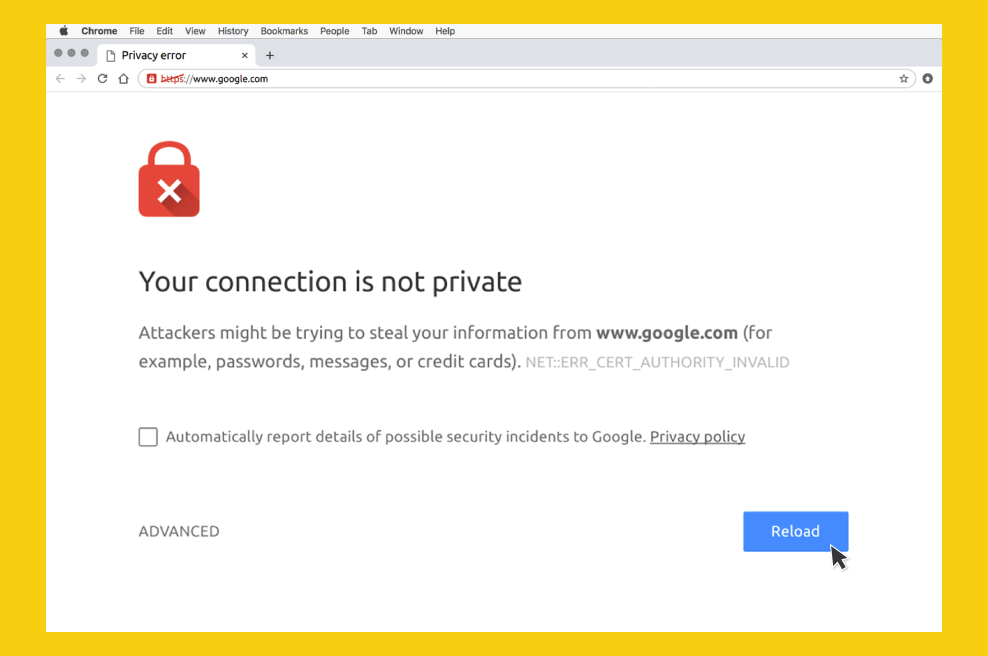
The warning means your browser could not confirm that the website is the one it claims to be, so it stopped before sending anything. The usual causes are a wrong date on your Mac, a Wi-Fi sign-in page, security software that inspects encrypted traffic, an outdated macOS, or a certificate that the site’s owner let expire. Find the cause and fix it. Clicking through the warning fixes nothing. It only switches the check off for that site.
What the warning looks like
- Chrome shows a page headed “Your connection is not private” with an error code below the text, for example NET::ERR_CERT_DATE_INVALID.
- Safari shows a page headed “This Connection Is Not Private” and says that the website may be impersonating the one you wanted. It has two buttons, Show Details and Go Back. For a site that uses no encryption at all, Safari shows “Not Secure” in the address field instead, which is a different message.
Every site that uses HTTPS sends your browser a certificate that proves its identity. The warning appears when that certificate has expired, was issued for a different address, or comes from an issuer your browser does not trust.
What the Chrome error codes mean
| Code | Meaning |
|---|---|
| NET::ERR_CERT_DATE_INVALID | By your Mac’s clock, the certificate has expired or is not valid yet. Either the clock is wrong or the site’s certificate ran out. |
| NET::ERR_CERT_COMMON_NAME_INVALID | The certificate was issued for a different address. This happens with a misconfigured site, with a Wi-Fi sign-in page and with an attacker posing as the site. |
| NET::ERR_CERT_AUTHORITY_INVALID | The certificate comes from an issuer Chrome does not trust: a self-signed certificate, security software or a company proxy that inspects traffic, or an attacker. |
| ERR_SSL_VERSION_OR_CIPHER_MISMATCH | A related error on a different page: the site only offers outdated encryption. Chrome does not connect to such sites and only the site’s owner can fix it. |
How to fix it
First check whether the warning appears on one site or on many. One site usually means the problem is on the site’s side. Many sites at once point to your Mac or your network.
1. Check the address and reload
Look for a typing mistake in the address, then reload the page with Command-R. A link with a slightly wrong address can lead to a server that has no certificate for it.
2. Check the date and time
Certificates are valid only for a set period, so a Mac with a wrong clock rejects valid ones. Chrome then shows “Your clock is behind” or “Your clock is ahead”, and Safari shows “Your Clock Is Set Incorrectly” with a button that opens the Date & Time settings.
- Open the Apple menu and choose System Settings.
- Click General, then Date & Time.
- Turn on Set time and date automatically.
On macOS 12 Monterey and earlier, the same setting is in System Preferences → Date & Time.
3. Sign in to the Wi-Fi network
Networks in hotels, cafes and airports often send every page to their own sign-in page until you log in or accept the terms. That redirect breaks encrypted connections and causes the warning. Google’s advice is to open an address that starts with http://, such as http://example.com. The sign-in page then loads, and after you sign in the warnings stop.
4. Try another network or device
Open the same site on your phone using mobile data. If the warning appears there as well, the site’s certificate is the problem and nothing on your Mac will fix it. Wait, or tell the site’s owner. If the site works on mobile data, the cause is your Mac or your Wi-Fi network.
5. Check antivirus, VPN and proxy software
Some antivirus apps offer “HTTPS scanning” or “HTTPS protection”. They put their own certificate between the browser and the site, and when that goes wrong, every secure site shows the warning. Google’s help page suggests turning that feature off to see whether the warning goes away. Turn the antivirus back on afterward. A VPN or a content filter can interfere in a similar way, so disconnect it and try again.
On a work computer, a company proxy that inspects traffic needs its certificate installed on your Mac. If it is missing, Chrome shows NET::ERR_CERT_AUTHORITY_INVALID. Ask your administrator, and do not install a certificate on your own.
6. Update macOS and the browser
Your Mac keeps a list of certificate issuers it trusts, and the list is updated with macOS. An old system does not know newer issuers. For example, certificates from the free issuer Let’s Encrypt are trusted only by macOS 10.12.1 and later, so Safari on an older Mac shows the warning on every site that uses them.
- Open System Settings → General → Software Update and install what is offered. Safari is updated with macOS.
- In Chrome, open the three-dot menu and choose Help → About Google Chrome. Chrome checks for an update. Click Relaunch if the button appears.
If Software Update offers nothing and the warnings appear in Safari on many sites, your macOS may be too old to receive updates. See how to update Safari on your Mac for what to do then.
7. Rule out an extension
Open the page in a private window. In Chrome, open the three-dot menu and choose New Incognito window. In Safari, choose File → New Private Window. If the page loads there, an extension is probably interfering. Turn your extensions off, then back on one at a time to find it.
When not to click through
Both browsers let you continue in many cases. In Chrome, click Advanced, then the link that starts with Proceed to and ends with (unsafe). In Safari, click Show Details, where you can view the certificate, and then the link visit this website. For some sites neither browser offers the link, for example when the site has told browsers never to connect without a valid certificate (HSTS).
Do not continue when:
- You are about to sign in, pay or enter any personal data. Apple’s advice is never to enter a password or card number on a site that shows such a warning.
- The site is your bank, your email or another site that normally works without a warning.
- You are on public Wi-Fi or any network you do not control.
- You do not know why the warning appeared.
Continuing is reasonable in one case: you know why the certificate is not trusted. An internal site of your company or a device on your own network may use a self-signed certificate, which no browser trusts by default. If you continue, check the address in the address bar first.
A different browser will not fix a bad certificate
All current browsers run the same checks. Kingpin, our private browser for Mac, uses the same engine as Chrome and tries an encrypted (HTTPS) connection first, so the causes and fixes on this page apply to it too.