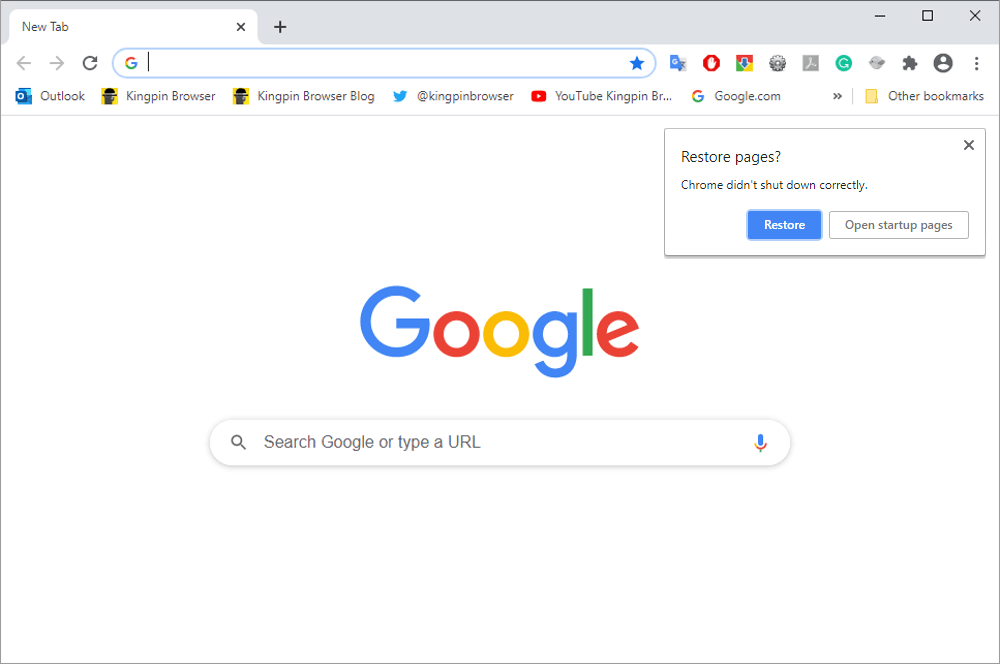
The message “Chrome didn’t shut down correctly” with the question “Restore pages?” appears when Chrome was closed without a normal exit: it crashed, it was force-closed, or the computer was switched off while Chrome was still open. Click Restore to get your tabs back. Seeing the message once is harmless. If it appears at every start, Chrome is not closing cleanly, and the fixes further down are for that.
Restore your tabs
- Click Restore in the message. Chrome reopens the windows and tabs from the last session.
- If you already closed the message, press Ctrl + Shift + T on Windows or Command + Shift + T on Mac. You can also click the three-dot menu, point to History and pick the closed window or tab from the list.
- If Chrome crashes again right after the pages come back, do not restore everything. Open History → History from the three-dot menu and open the pages you need one at a time. The page that brings Chrome down, or an extension that acts on it, is the one to avoid.
Make Chrome reopen your tabs at every start
If you always want your last tabs back, you do not have to wait for the message.
- Click the three-dot menu and choose Settings.
- Click On startup on the left.
- Select Continue where you left off.
Chrome then reopens the pages you had open when you quit. Your cookies are kept as well, so sites where you were signed in open signed in.
If the message appears at every start
Work through these in order and restart Chrome after each one.
- Quit Chrome before you shut down the computer. On Windows, click the three-dot menu and choose Exit. On Mac, choose Chrome → Quit Google Chrome in the menu bar or press Command + Q.
- Update Chrome. Click the three-dot menu, choose Help → About Google Chrome and click Relaunch if it is offered.
- On Windows, stop Chrome from running in the background. Open Settings → System and turn off Continue running background apps when Google Chrome is closed. With this setting on, Chrome can still be running when you think it is closed. Chrome on Mac does not have this setting.
- Free up memory. Google’s first suggestion for a crashing Chrome is that the computer may have run out of memory. Close tabs you do not need, quit other apps and pause large downloads.
- Check your extensions. Click the three-dot menu and choose Extensions → Manage extensions. Switch all of them off, then turn them back on one at a time until the crash returns.
- Turn off graphics acceleration. Open Settings → System, turn off Use graphics acceleration when available (“Use hardware acceleration when available” in older versions) and restart Chrome. Turn it back on if nothing changes.
- Check your security software. Google notes that antivirus programs and unwanted software can interfere with Chrome. On Windows, open the Windows Security app and run a Quick scan under Virus & threat protection.
- Reset Chrome settings. Open Settings → Reset settings, click Restore settings to their original defaults and then Reset settings. This turns off your extensions and deletes cookies. Bookmarks, history and saved passwords are not affected.
Google’s own checklist is on its page Fix Chrome if it crashes or won’t open.
Test with a new profile
Chrome keeps your bookmarks, history, extensions and settings in a profile. If that profile is damaged, the message can come back no matter what you change. A second profile shows whether that is the case.
- Click the profile icon at the top right of the Chrome window.
- Choose Add Chrome profile and follow the steps.
- Use the new profile for a while. Close and reopen Chrome a few times.
If the message does not appear in the new profile, the old one is the problem. Sign in to Chrome in the new profile to bring over the bookmarks and passwords saved in your Google Account. Older guides tell you to rename the “Default” folder inside Chrome’s data folder instead. A new profile gives you the same fresh start without changing files by hand.
Reinstall Chrome with a clean profile
This is the last resort. Deleting the profile removes the bookmarks, history and saved passwords that are stored only on this computer. Before you start, sign in to Chrome and check that your data is saved in your Google Account, or export your bookmarks.
- Windows 11: close Chrome. Open Settings → Apps → Installed apps, click the three dots next to Google Chrome and choose Uninstall. Tick Also delete your browsing data when the uninstaller offers it. On Windows 10 the list is under Settings → Apps → Apps & features.
- Mac: quit Chrome and drag Google Chrome from the Applications folder to the Trash. To delete the profile as well, choose Go → Go to Folder in Finder, enter ~/Library/Application Support/Google/Chrome and move the folders you find there to the Trash.
Then download Chrome again from google.com/chrome. Our guide to uninstalling Chrome completely covers the details.
A note on our browser
Kingpin, our private browser for Mac, works the other way round. By default it remembers nothing after you quit, so there are no tabs to restore. That suits private browsing, not people who want yesterday’s tabs back.