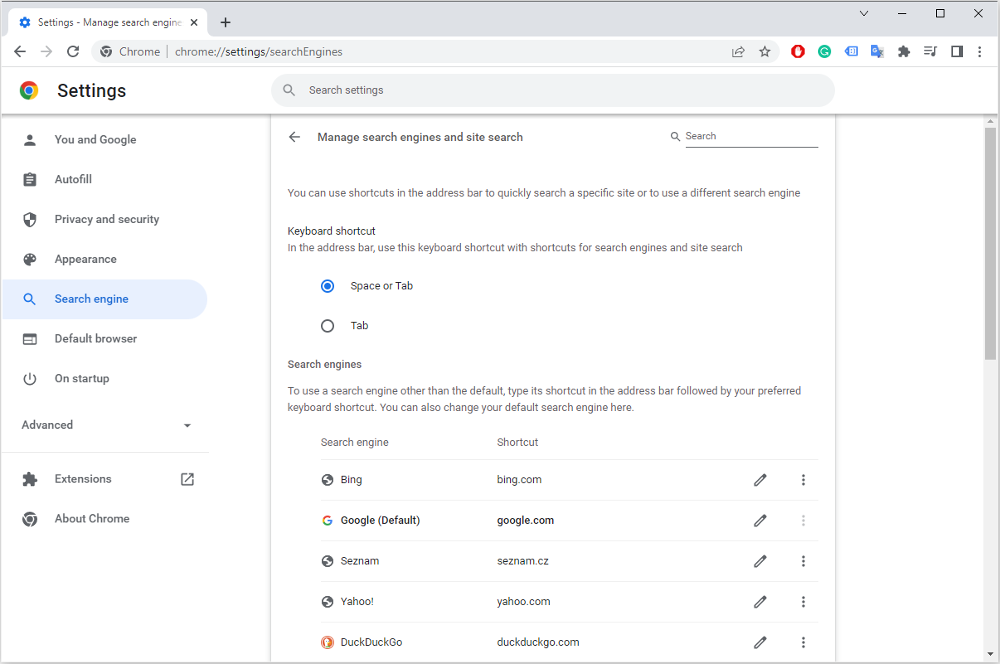
To remove a search engine from Chrome, open Settings → Search engine → Manage search engines and site search, click the three dots next to the engine and choose Delete. Chrome lets you delete any engine in the list except the one that is set as the default, so if you want to remove the default, make another engine the default first.
Change the default search engine
The default search engine is the one Chrome uses when you type words in the address bar. If searches open in an engine you did not pick, start here.
- Open Chrome, click the three-dot menu at the top right and choose Settings.
- Select Search engine on the left.
- Under Search engine, click Change and pick the engine you want.
In some countries Chrome comes with Google Search as the default. In others it asks you to choose a default search engine yourself. Either way you can change it here at any time.
How to remove other search engines
- Open Settings → Search engine → Manage search engines and site search.
- Find the engine you want to remove in the list.
- Click the three dots to the right of it and choose Delete. Confirm if Chrome asks.
- Repeat for every engine you do not want.
Chrome does not let you delete the engine that is currently the default. Choose Make default on another engine and the old default can then be deleted like the rest. Chrome always keeps one default, so the list cannot be emptied completely.
The same page has a second list, Site search. These are shortcuts for searching one website from the address bar. Each has Edit and a three-dot menu with Make default, Deactivate and Delete. A deactivated shortcut moves to Inactive shortcuts. Chrome also places sites there by itself after you search on them. They do nothing until you click Activate.
A few entries cannot be deleted. The built-in shortcuts for open tabs, bookmarks and history can only be edited or turned off, and the Gemini shortcut cannot be edited or deleted.
Use a search engine that is not in the list
If the engine you want is missing, add it and make it the default. After that you can delete all the others.
- On the Manage search engines and site search page, click Add next to Site search.
- Fill in a name and a shortcut (a short keyword you can type in the address bar).
- In the URL field, enter the address of the engine’s results page with %s in place of the search words. To get it, run a search on that engine, copy the address of the results page and replace your search words with %s.
- Click Add, then open the three-dot menu next to the new entry and choose Make default.
If a search engine you removed keeps coming back
A search engine that changes by itself is a sign that something other than you controls the setting. Google’s help page says that you might have malware. Check these in turn:
- Extensions. An extension can take over search. Open More → Extensions → Manage extensions and remove every extension you do not recognize or no longer use.
- Unwanted programs. A program you install can change Chrome’s settings without telling you. Uninstall programs you do not recognize: on Windows 11 in Start → Settings → Apps → Installed apps, on a Mac by moving them from Applications to the Trash. Then run a scan with your antivirus program.
- Chrome settings. Reset them in Settings → Reset settings → Restore settings to their original defaults. This returns the search engine, startup pages and site permissions to the defaults and turns off extensions. Bookmarks and saved passwords stay.
- A managed browser. At work or school the administrator can choose the search engine and lock the list. If the three-dot menu in Chrome ends with Managed by your organization, ask the administrator.
Google describes the cleanup in more detail on its page Remove unwanted ads, pop-ups & malware. Reinstalling Chrome does not help while the program that changes the setting is still on the computer.
Search engines in our browser
Kingpin, our private browser for Mac, uses Google as the default search engine and lets you switch to DuckDuckGo, Bing or Yandex. It has no extensions, so no add-on can change the search engine.